Disclosure: this post contains Amazon affiliate links. If you buy through them I earn a small commission at no extra cost to you. I only link to products I would use in my own workspace.
A small office punishes every bad storage decision. Buy the wrong shelf and you lose the floor space you were trying to save.
These are 13 approaches that work in genuinely small rooms, ordered roughly from cheapest to most involved. If you only have ten minutes, the table below covers the five that solve the most common problems.
Quick Picks
| Product | Best for | Price band | |
|---|---|---|---|
| Rustic floating shelf set (3-pack) | Zero floor space — the first thing to buy | $30–75 | Check price |
| ELAFROS 3-tier rolling utility cart | Storage that moves out of the way when you need the room | $150+ | Check price |
| INCLY 278-piece pegboard kit | Lots of small items, constantly changing | $75–150 | Check price |
| IRONCK 6-tier tall bookshelf | Maximum storage from the smallest footprint | $30–75 | Check price |
| Foldable storage ottoman | Doubling up — seat, footrest and hidden storage | $30–75 | Check price |
How to choose
- Go vertical before you go wider. Wall space is the only space a small office has spare.
- Anything on the floor should move. Wheels or fold-flat, otherwise it becomes permanent clutter.
- Closed storage for ugly things, open shelves for the rest. All-open looks messy; all-closed looks like a storage unit.
1. Floating Shelves

Best for: anyone starting from scratch. This is the highest-return purchase on the list.
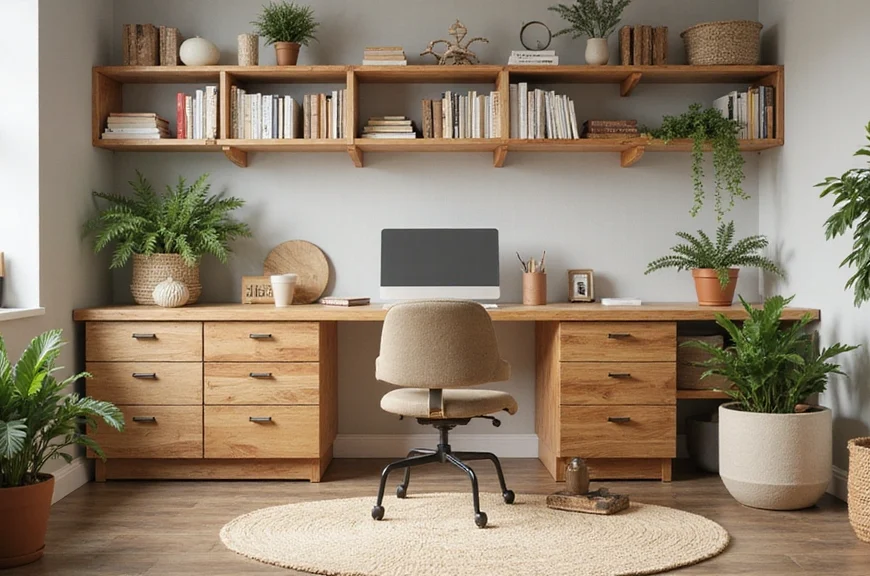
Floating shelves take no floor space and draw the eye upward, which makes a small room read as taller. Mounted above the desk they put your most-used items within reach without eating work surface.
A rustic wood 3-shelf set holds around 22lb per shelf — enough for books, a plant and a few files. Mix in linen storage boxes so half the shelf stays visually quiet, and add a few frames if the wall starts to feel utilitarian.
Watch out for: stud spacing. Drywall anchors alone will not hold 22lb reliably over time.
2. Under-Desk Storage

Best for: reclaiming desk surface without adding furniture to the room.
The space under a desk is usually wasted. A rolling cart such as the ELAFROS 3-tier utility cart slides underneath, holds supplies and electronics, and rolls out when you need it — or out of the room entirely when you have guests.
Add collapsible fabric cube bins on the shelves so small items do not migrate, and a YouCopia adjustable drawer organiser if you have a shallow drawer that has become a junk drawer.
Watch out for: cart height. Measure your desk clearance before ordering — most carts are 26–30in.
3. Multi-Functional Furniture

Best for: rooms under about 8ft square, where every piece has to earn its place twice.
A desk with built-in shelving removes the need for a separate bookcase entirely. A foldable storage ottoman is a footrest, a spare seat and a place to hide cables and throws. A drop-leaf table gives you a second surface for the two days a month you need one, then folds flat.
Watch out for: desks with fixed shelving on one side lock you into a room layout. Check which side before buying.
4. Pegboards

Best for: scissors, cables, tools, tape — anything that gets used daily and never has a home.
A pegboard turns a blank wall into reconfigurable storage. The INCLY 278-piece kit fits 1/8in or 1/4in board and includes hooks, bins and pegs, so you are not buying accessories separately. For bulkier items like notebooks or a tablet, HORUSDY square baskets hang off the same board.
Watch out for: hook gauge. Buying a board and hooks separately is how people end up with hooks that do not fit.
5. Vertical Storage

Best for: the most storage per square foot of floor, full stop.
A tall, narrow unit beats a wide, short one in a small room every time. The IRONCK 6-tier bookshelf gives six levels on a small footprint. Ultrawall wall-mounted racks take files off the floor entirely, and a SUNMORY corner unit uses the one area almost everyone wastes.
Watch out for: anything over about 5ft needs anti-tip anchoring, especially with pets or children in the house.
6. Bins and Baskets

Best for: making open shelving look deliberate rather than cluttered.
Bins are what stop open shelves from becoming visual noise. Coloured fabric bins work for supplies you reach for often; wicker baskets in a 3-size pack add texture and handle the awkward mid-sized things. A label maker sounds excessive until the third time you have opened four bins looking for one cable.
Watch out for: measure shelf depth first. Bins that overhang look worse than no bins.
7. Door Storage

Best for: tiny offices where the walls are already full.
The back of the door is usually the last unused surface in the room. A clear over-door organiser lets you see contents at a glance; a fabric pocket organiser looks tidier if the door is visible from your desk. A magnetic strip mounted on the frame handles scissors and small metal tools.
Watch out for: over-door hooks stop many doors closing flush. Adhesive strips avoid this.
8. Desk Organisers

Best for: the 20 minutes a week you currently spend looking for a pen.
Three options depending on your aesthetic and paper volume. A 4-tier wood organiser for warmth and moderate paperwork. An acrylic stackable organiser if you want it to disappear visually. A 9-tier stackable set if you genuinely handle a lot of paper.
Watch out for: buying more compartments than you have categories. Empty slots fill with junk.
9. Magnetic Strips

Best for: small metal items that vanish into drawers.
A magnetic strip with adhesive backing mounts above the desk or on the side of a filing cabinet. Pair it with small labelling magnets for notes, or a heavier magnetic tool holder if you also use the room for making things.
Watch out for: keep magnets well away from external hard drives.
10. Hidden Storage in Furniture

Best for: offices that double as guest rooms or living space.
A lift-top coffee table hides supplies and gives you a standing-height surface when raised. A side table with fabric drawers keeps essentials to hand without looking like office furniture.
Watch out for: lift-top mechanisms are the first thing to fail. Check the weight rating.
11. A Filing System

Best for: anyone who still has paper and no system for it.
Colour-coded folders do most of the work — categories become visible rather than something you read. A vertical file organiser keeps live projects upright and reachable, and archive the rest into a lidded storage box on a high shelf.
Watch out for: scan and bin before you file. Most people are organising paper they will never open again.
12. Cable Management

Best for: the single cheapest change that makes a desk look tidy.
Adhesive cable clips along the desk edge stop cords hanging. A cable management box hides the power strip and the excess. A wire basket mounted under the desk takes the whole tangle off the floor.
Watch out for: label both ends of every cable while you are doing it. You will not do it later.
13. Repurposed Items

Best for: spending nothing, or adding character to a room that feels like a showroom.
Mason jars hold pens and brushes and cost almost nothing. A ladder shelf leans against a wall with no mounting required — useful if you rent. Decorative trays group small items so a surface reads as arranged rather than covered.
Where to start

If you buy one thing: the floating shelves. They cost the least, take the least space, and solve the most.
If your problem is desk clutter rather than room clutter: the rolling cart.
If you have lots of small things and no system: the pegboard kit.
Prices and availability change. Links go to the current Amazon listing.