This article contains affiliate links. If you purchase through one of these links, AllInsides may earn a commission at no additional cost to you. As an Amazon Associate, I earn from qualifying purchases.
A small kitchen does not necessarily need more cabinets. More often, it needs a clearer system.
When utensils, food containers and cleaning supplies compete for the same limited space, even an adequately sized kitchen can feel cramped. Counters become temporary storage, drawers turn into mixed collections, and ingredients disappear at the back of the refrigerator.
The solution is to organize the kitchen around how you actually use it. That means giving frequently used items convenient homes, removing unnecessary duplicates and preventing storage areas from becoming catch-all spaces.
Here is a practical way to organize a small kitchen without renovating or adding permanent cabinetry.
Key Takeaways
- Edit before organizing: Remove duplicates, expired food and items that do not belong in the kitchen before buying storage products.
- Create practical zones: Store items close to where they are used so cooking, cleaning and food preparation require fewer steps.
- Measure every space: Check usable drawer, cabinet and refrigerator dimensions before ordering organizers.
- Protect preparation space: Keep at least one uninterrupted section of countertop clear for everyday cooking.
- Choose maintainable systems: The best arrangement is one you can restore during a quick weekly reset.
Contents
- 1. Declutter Before You Organize
- 2. Divide the Kitchen Into Working Zones
- 3. Turn Messy Drawers Into Useful Storage
- 4. Clear the Counter Around Your Sink
- 5. Use the Refrigerator as Organized Storage
- 6. Reclaim Vertical Cabinet Space
- 7. Give Every Countertop Appliance a Test
- 8. Use Doors and Walls Carefully
- 9. Create a 15-Minute Weekly Reset
- How to Choose Storage for a Small Kitchen
- Frequently Asked Questions
1. Declutter Before You Organize
Before buying organizers, take everything out of one storage area at a time. Starting with a single drawer or cabinet keeps the project manageable and prevents the entire kitchen from becoming a temporary disaster zone.
Sort what you find into four groups:
- Used every day
- Used occasionally
- Belongs somewhere else
- Ready to donate or discard
Pay particular attention to duplicate utensils, food containers without matching lids, expired ingredients and appliances that have not been used in the past year.
The goal is not to create an extremely minimal kitchen. It is to ensure that every item taking up valuable space is useful enough to deserve it.
Avoid purchasing organizers until this step is complete. Otherwise, you may simply organize items you do not need.
2. Divide the Kitchen Into Working Zones
A well-organized kitchen stores items close to where they are used. Even a very small kitchen can be divided into simple activity zones.
Food-preparation zone
Keep chopping boards, knives, mixing bowls and frequently used utensils near your main preparation surface.
Cooking zone
Store pots, pans, cooking tools, oils and everyday seasonings close to the stove—but not so close that heat affects them.
Cleaning zone
Place dishwashing supplies, cloths, brushes and waste-related items around the sink.
Food-storage zone
Keep wraps, reusable containers and bags together, ideally near the refrigerator.
Drinks zone
Group mugs, glasses, tea and coffee supplies in one location. If several people prepare drinks throughout the day, placing this zone away from the main cooking area can reduce congestion.
Zones prevent you from crossing the kitchen repeatedly to complete one task. They also make it easier for everyone in the household to return items to the correct place.
3. Turn Messy Drawers Into Useful Storage
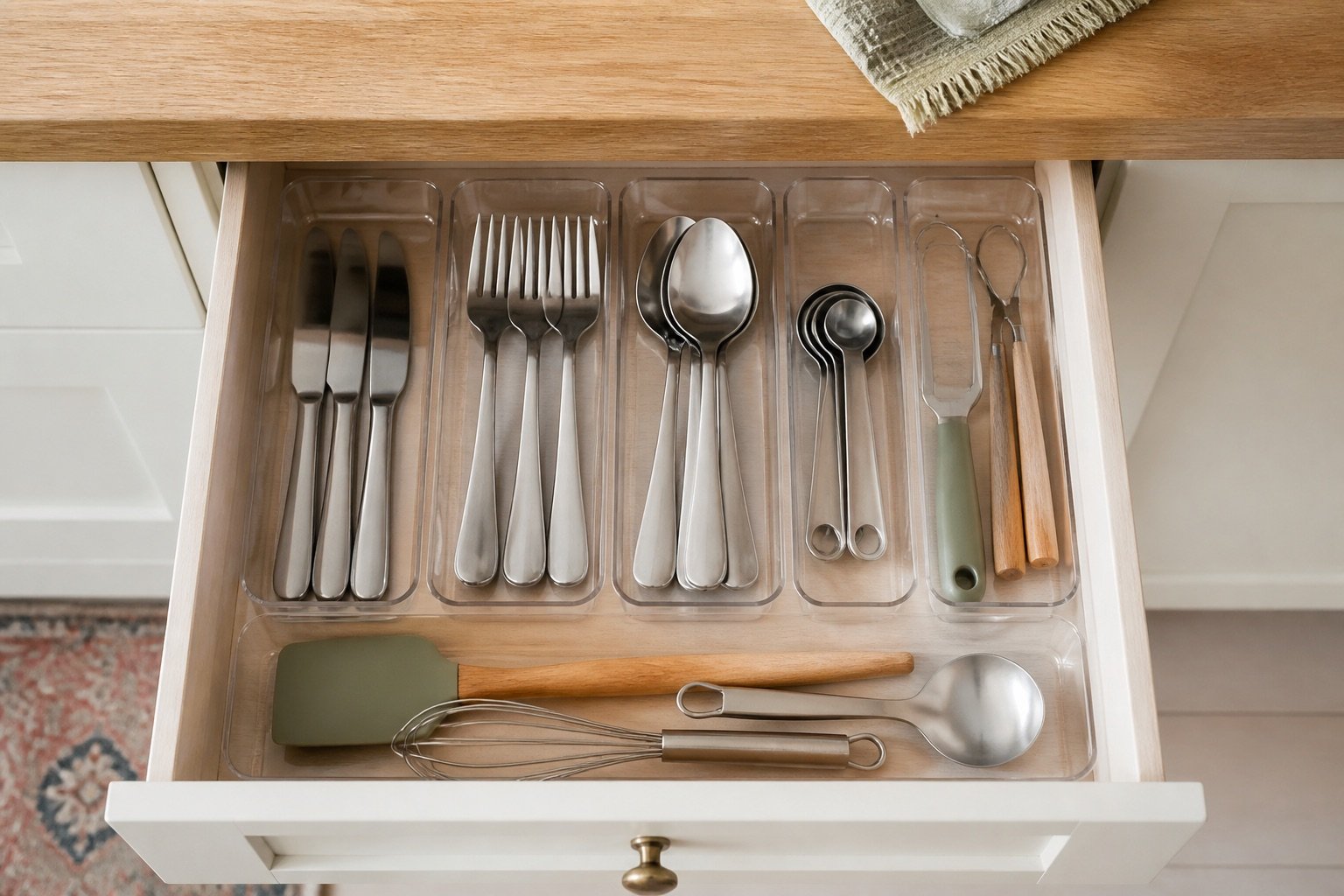
Kitchen drawers often waste space because small items slide around and overlap. The answer is not necessarily a single large cutlery tray. A collection of smaller trays can adapt more easily to unusual drawer dimensions.
Measure the width, depth and height of each drawer before selecting organizers. Then assign each compartment one clear purpose, such as everyday cutlery, cooking utensils, measuring tools, food-storage accessories or small gadgets.
The Vtopmart 25-piece clear drawer organizer set contains several tray sizes that can be combined to suit different drawers. The clear design also makes it easy to see each category.
Best for: Households with several drawers containing mixed utensils and small accessories.
Skip it if: Your drawers are unusually shallow or you only need to divide one cutlery drawer.
Do not fill every available compartment. A little empty space makes the system easier to maintain and leaves room for items you may genuinely need later.
4. Clear the Counter Around Your Sink
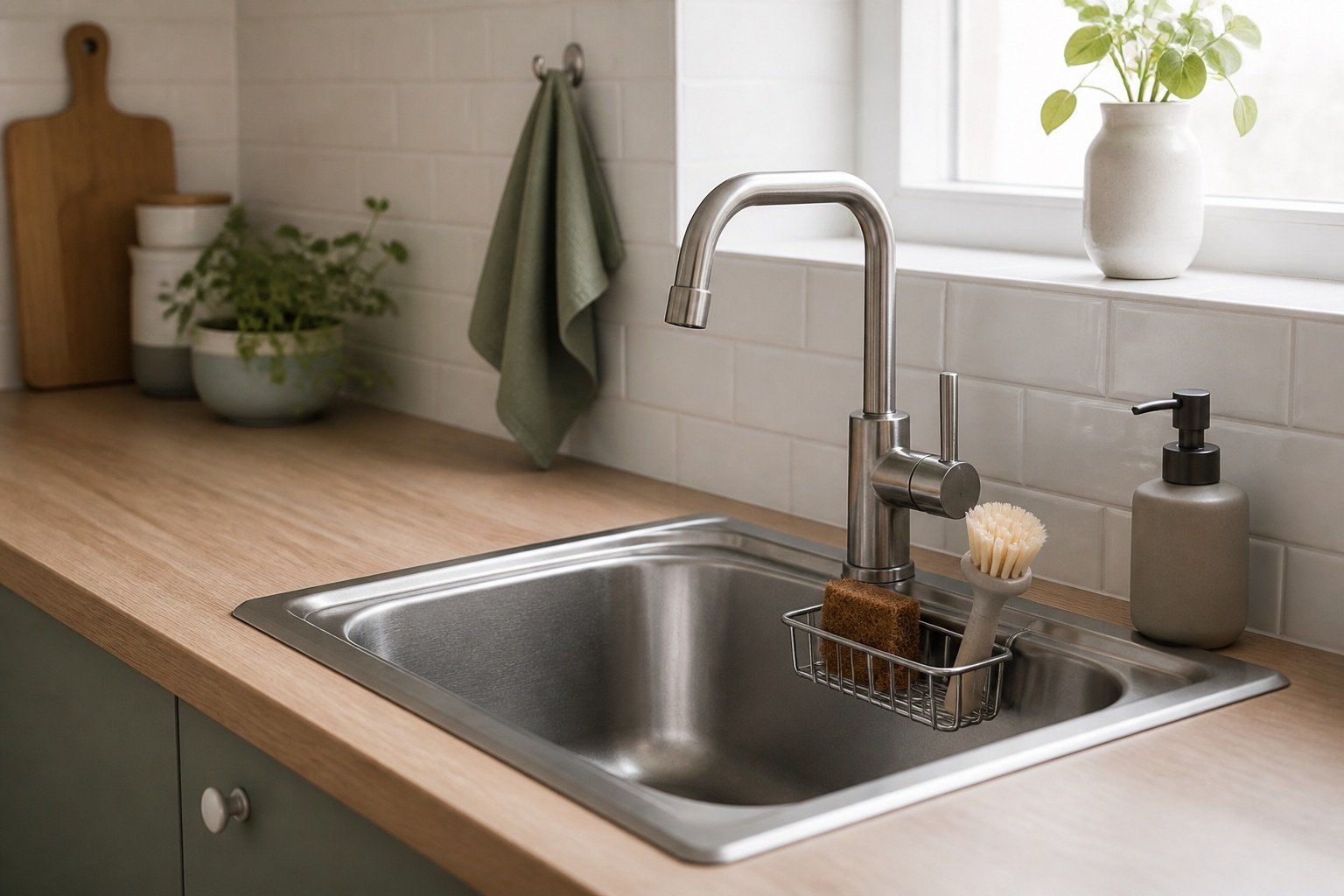
The sink is one of the hardest-working areas in a kitchen. When brushes, sponges, soap and cloths are spread around it, the entire counter can look untidy.
Start by discarding worn cleaning tools and duplicates. Keep only the products used regularly beside the sink. Store refills and occasional cleaning supplies underneath it.
A compact sink organizer can group the remaining items vertically instead of allowing them to spread across the counter. The Cisily sink organizer with brush holder is one option for keeping a sponge, brush and soap together.
Best for: Kitchens where several washing-up tools regularly collect around the faucet.
Skip it if: You already have built-in sink storage or prefer to keep the counter completely empty.
Whichever organizer you choose, clean underneath it regularly. Kitchen storage should make surfaces easier to maintain—not create a hidden area for water and residue.
5. Use the Refrigerator as an Organized Storage Area
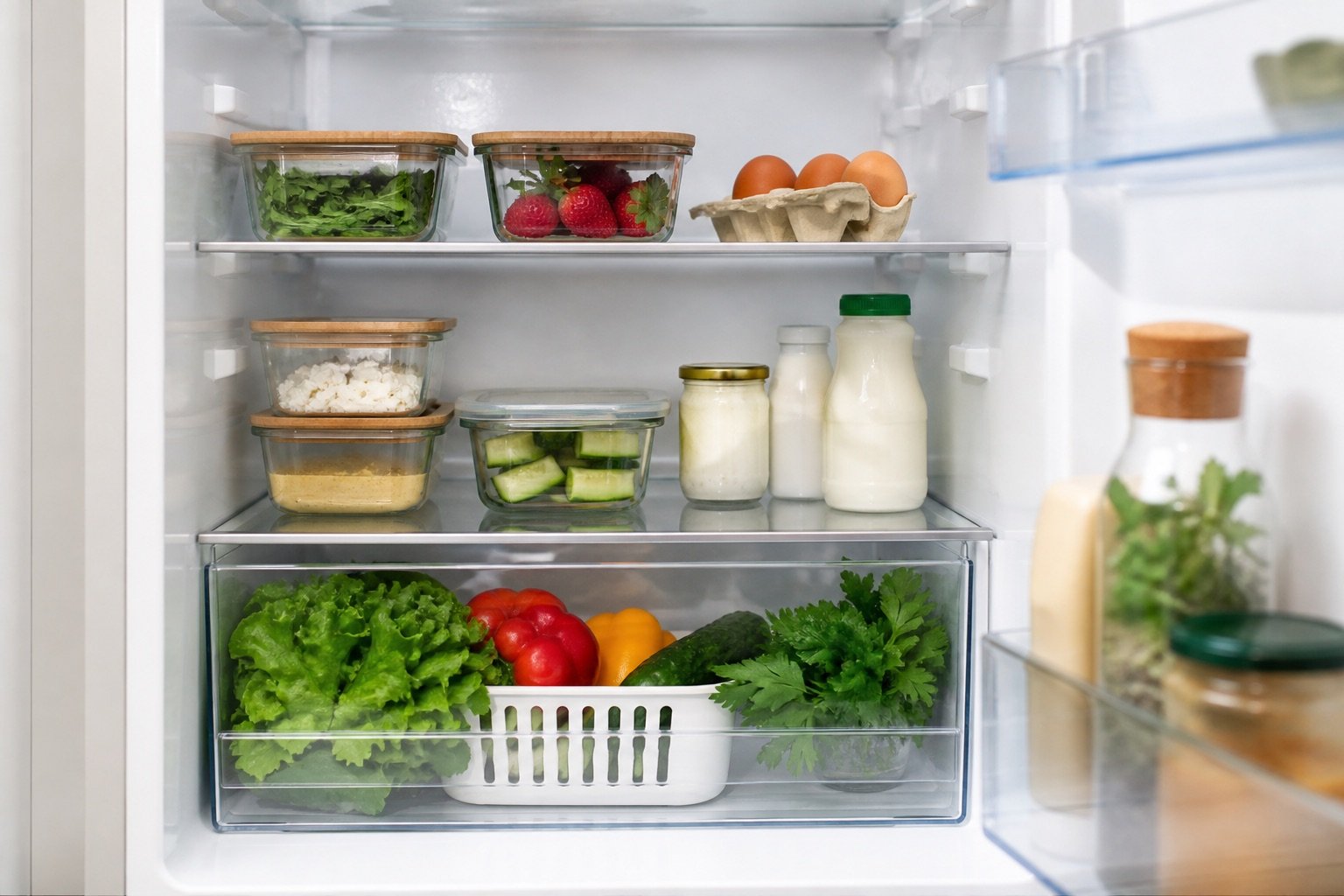
A disorganized refrigerator wastes both space and food. Items placed at the back are easily forgotten, while loose produce and packages make shelves difficult to clean.
Instead of treating every shelf as general storage, assign broad categories: ready-to-eat foods, meal ingredients, dairy, produce, condiments and leftovers.
Keep older items toward the front so they are used first. Avoid filling every shelf with containers; cold air still needs room to circulate.
Produce containers can help separate fruit and vegetables while making them easier to see. This five-piece refrigerator produce-container set includes containers with removable colanders.
Best for: Households that regularly lose small produce items in refrigerator drawers or want to rinse and separate ingredients.
Skip it if: Your refrigerator already has effective produce drawers or the containers would reduce rather than improve usable shelf space.
Measure your refrigerator shelves before ordering any container set. A popular product is not useful if its dimensions do not suit your appliance.
6. Reclaim Vertical Cabinet Space
Many cabinets have a large gap between the top of one stack and the shelf above it. This is particularly common around plates, bowls and mugs.
You can reclaim this space with stackable shelf risers, under-shelf baskets, plate racks, vertical dividers or stackable food-storage containers.
Choose only one method for each cabinet. Combining too many storage products can make a small cabinet harder to access.
Store heavy items on lower shelves and lighter pieces above. Everyday objects should remain between waist and eye level whenever possible.
For baking trays, chopping boards and pan lids, vertical storage is often more effective than stacking. You can remove one item without lifting everything above it.
7. Give Every Countertop Appliance a Test
Counter space should support food preparation rather than serve as permanent parking for every appliance you own.
Ask three questions about each appliance:
- Is it used at least once a week?
- Is it difficult or unsafe to move?
- Does keeping it visible make cooking noticeably easier?
An appliance that fails all three questions can probably be stored elsewhere.
If an appliance remains on the counter, group its accessories nearby. Coffee beans and filters can sit above or beside the coffee machine, for example, rather than occupying an unrelated drawer across the kitchen.
Try to preserve at least one uninterrupted section of counter as a dedicated preparation area. Even a modest clear surface can make a small kitchen feel much more functional.
8. Use Doors and Walls Carefully
Cabinet doors and unused wall areas can provide additional storage, but only when they do not obstruct movement. Possible solutions include a rail for lightweight utensils, a magnetic knife holder, adhesive hooks for oven gloves, an over-door pantry organizer or a wall-mounted paper-towel holder.
Check the weight limit and installation instructions before attaching anything. Avoid placing storage where it could interfere with cabinet shelves, plumbing, electrical outlets or door closure.
Visible storage works best when it holds a small number of frequently used items. Covering every wall with utensils can make the room feel more crowded.
9. Create a 15-Minute Weekly Reset
A kitchen organization system succeeds only if it is easy to restore.
- Return misplaced items to their zones.
- Check the refrigerator for food that should be used soon.
- Match containers with their lids.
- Clear unnecessary papers and packaging.
- Wipe organizers and the surfaces underneath them.
- Move rarely used items out of prime storage positions.
This reset should take approximately 15 minutes. If it consistently takes much longer, the system may be too complicated or the kitchen may still contain too many items.
How to Choose Storage Solutions for a Small Kitchen
Before choosing any organizer, match the product to a specific recurring problem. The comparison below follows the same practical approach used throughout this guide.
| Kitchen problem | Most useful solution | Check before buying |
|---|---|---|
| Loose utensils | Modular drawer trays | Interior drawer height and width |
| Crowded sink area | Compact draining caddy | Drainage, rust resistance and footprint |
| Forgotten produce | Clear refrigerator containers | Shelf depth and airflow |
| Wasted cabinet height | Shelf risers or vertical dividers | Door clearance and load capacity |
| Busy countertops | Appliance edit and activity zones | How often each item is actually used |
Small-Kitchen Mistakes to Avoid
Buying containers before measuring
Always measure the usable interior space—not just the outside of the drawer, cabinet or refrigerator.
Decanting everything for appearance
Matching containers can look attractive, but transferring every ingredient creates additional work. Decant only foods that benefit from visibility, freshness or easier pouring.
Using organizers to hold clutter
An organizer does not make an unnecessary object useful. Edit first and organize second.
Stacking items too high
A tall stack may technically fit, but it is not efficient if everything must be removed to reach the bottom item.
Ignoring daily habits
The most attractive storage system will fail if it forces people to cross the kitchen or complete several steps to put something away.
Frequently Asked Questions
How can I organize a small kitchen on a limited budget?
Begin with decluttering and rearranging before buying anything. Reuse clean boxes or shallow containers as temporary drawer dividers. Purchase a permanent organizer only after confirming that the new arrangement works.
How do I organize a small kitchen with very few drawers?
Reserve drawers for small items that are difficult to stack. Move larger utensils to a compact countertop container or wall rail, store pans in cabinets and use vertical dividers for flat items.
Should kitchen counters be completely empty?
Not necessarily. Keep items that you use frequently and that support a clear activity zone. The objective is functional counter space, not an empty room.
Where should rarely used kitchen appliances go?
Store them in the highest or lowest cabinet spaces, a nearby pantry or another suitable household storage area. Very heavy appliances should remain somewhere safe and easy to lift.
Are clear kitchen organizers better?
Clear organizers make contents visible, which can reduce forgotten items. However, the correct dimensions and a simple category system matter more than the material or appearance.
Conclusion
Organizing a small kitchen is less about fitting something into every available gap and more about making everyday actions easier.
Start by removing what you no longer need. Establish practical work zones, make drawers easier to scan and protect a clear area for food preparation. Add organizers only where they solve a specific, recurring problem.
For more carefully selected storage options, visit the AllInsides Amazon storefront.
The best kitchen organization system is not the one that looks perfect immediately after a makeover. It is the one you can still maintain on a busy weekday.